Frequencies · 432 Hz and 528 Hz
432 Hz or 528 Hz: which one is calling you?
When the noise of the day finally settles and you go looking for a sound to come home to, two numbers keep finding you: 432 and 528. They are not rivals. One is a way of tuning music that many feel is closer to nature; the other is a single tone that tradition ties to love and transformation. Here is what each one holds, and how to know which one is yours tonight.
Two kinds of sound
Two different doors
432 Hz and 528 Hz are often spoken of as if they were the same kind of thing, but they open different doors. 432 Hz is a way of tuning a whole piece of music: every note is lowered by a breath, so that the A sings at 432 instead of the usual 440. The music becomes softer and a little deeper, like light at dusk. 528 Hz is a single, steady tone, one thread of sound you can rest your attention on. One is a landscape you walk into. The other is a candle you sit beside.
The meaning of 432
432 Hz: the sound of harmony with nature
Those who love 432 Hz describe it as warmer and more natural, as if the music were breathing with the earth instead of pressing against you. In the traditions that have grown around it, 432 is the number of harmony: with nature, with the slow rhythms of the body, with something larger than yourself. Many people feel it as a softening, the shoulders dropping, the mind becoming a quiet room. It is often called “Verdi tuning”, after the composer Giuseppe Verdi, who in 1884 wrote in favour of a lower, gentler concert pitch.
The meaning of 528
528 Hz: the tone of love and transformation
528 Hz is known as the love frequency. It is the “Mi” of the Solfeggio tones, and in the medieval hymn those syllables come from, Mi begins the word mira, “wonders”. Tradition gives it the meaning of transformation and miracles: the moment something in you is ready to change. In Gemflow it belongs to citrine, the golden stone of the solar plexus, the place many traditions call the seat of your own power. Where 432 invites you to soften, 528 invites you to gather your light and step forward. Its story is on our 528 Hz page.
Listening inward
How to know which one is calling you
There is no right answer, only the one that answers you. Sit somewhere quiet, close your eyes, and listen to each for a few minutes, on different evenings. Notice where you feel it. If 432 feels like being held, like roots settling into the ground, it may be what you need right now: rest, calm, a return to your own rhythm. If 528 feels like warmth gathering in your centre, like a door opening, it may be calling you toward change, courage and love for yourself. What calls you can change with the seasons of your life. And if neither feels quite right, the other Solfeggio tones are waiting: 396 Hz for grounding, 639 Hz for the heart, 741 Hz for your voice, and 963 Hz for the crown. All nine are gathered on Solfeggio frequencies.
A small ritual
Bringing 432 Hz or 528 Hz into your meditation
Dim the lights. Hold one intention in your mind, a single sentence for what you are asking of tonight. Let the sound play softly, quiet enough that you could speak over it. Breathe in for four counts and out for six, and let your attention rest on the music or the tone. Stay for ten minutes, or for as long as it holds you. When you open your eyes, write down one word for what you felt. Give each sound its own evening rather than playing them together: they live in different tunings, and each is clearer on its own.
Your daily ritual
Let a stone bring you back to yourself
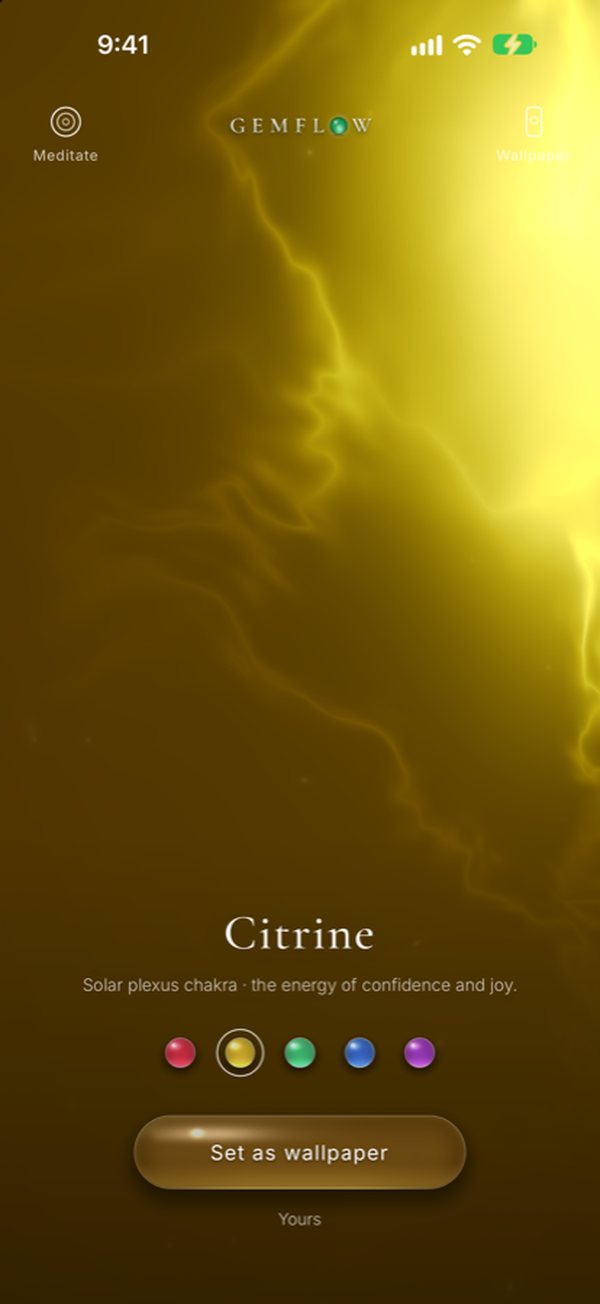
Citrine in the Gemflow app. The light is alive, rendered in real time, not a video.
Gemflow is a quiet ritual for coming back to yourself. It does not have a 432 Hz stone; it is built around single tones, each held by a living stone: ruby 396, citrine 528, emerald 639, sapphire 741 and amethyst 963 Hz. Touch the light and guide it with your finger, or open Meditate, where your stone breathes with you and its tone rests beneath guqin and real singing bowls. If 528 is calling you, citrine’s golden light is waiting. Let a stone keep you company as you return to yourself, every day.
432 Hz and 528 Hz at a glance
| 432 Hz | 528 Hz | |
|---|---|---|
| What it is | A tuning: the A above middle C set to 432 Hz, every other note moved with it | A single tone, 528 vibrations a second |
| Often felt as | Harmony with nature, softness, rest | Love, transformation, inner power |
| Also called | “Verdi tuning”, “natural tuning” | “Love frequency”, the “Mi” of the Solfeggio scale |
| Where the idea comes from | Debates about concert pitch since the 19th century | The Solfeggio frequencies, made popular in 1999 |
| In Gemflow | Not in the app | Citrine’s tone, in Meditate |
A little history
How 432 and 440 came to be
For a long time there was no shared pitch, and the A of one city’s organ could sit far from another’s. In 1859 France set its A at 435 Hz, and much of Europe followed. In 1884 Verdi wrote to an Italian government commission in support of a lower, fixed pitch; accounts differ on whether he favoured 435 or 432 Hz, and Italian military bands are said to have been tuned to 432 that year. A = 440 Hz was agreed at an international conference in London in 1939 and became the ISO standard (Recommendation R 16 in 1955, ISO 16 in 1975), which is the pitch most music uses today. The name “Verdi tuning” for 432 Hz spread from the late 1980s.
Questions
Is 432 Hz better than 528 Hz?
Neither is better; they are different kinds of sound. 432 Hz is a way of tuning a whole piece of music, often felt as soft and natural. 528 Hz is a single tone, traditionally linked to love and transformation. Choose the one you are drawn to.
What is 432 Hz?
A tuning in which the A above middle C is set to 432 vibrations per second instead of the usual 440. Every other note is lowered with it, by about a third of a semitone, so the music sounds slightly deeper and softer.
What is the difference between 432 Hz and 440 Hz?
About a third of a semitone (32 cents): music tuned to 432 Hz sounds slightly lower. 440 Hz is the international standard pitch (ISO 16); 432 Hz is an alternative some listeners and musicians prefer.
Why is 432 Hz called Verdi tuning?
In 1884 the composer Giuseppe Verdi wrote to an Italian government commission in favour of a lower, fixed concert pitch. Accounts differ on whether he asked for 432 or 435 Hz. The name “Verdi tuning” spread from the late 1980s.
Is 432 Hz a Solfeggio frequency?
No. The Solfeggio frequencies (174 to 963 Hz) are single tones, made popular by Leonard Horowitz’s 1999 book Healing Codes for the Biological Apocalypse. 432 Hz is a tuning for the note A, an alternative to the standard A = 440 Hz. The two ideas are often mentioned together.
What are the benefits of 432 Hz?
Some people find 432 Hz music softer and easier to rest in. A small pilot study (Calamassi and Pomponi, Explore, 2019) found a slightly lower average heart rate after music tuned to 432 Hz than after the same music at 440 Hz. It is a way to relax, not a treatment.
Is 432 Hz music safe?
Yes, at a comfortable volume. It is ordinary music at a slightly lower pitch; the WHO–ITU safe-listening guidance suggests around 80 decibels or lower.
Can I listen to 432 Hz and 528 Hz together?
They sit in different tunings, so together they can sound slightly out of tune. Much “528 Hz music” is tuned to A = 444 Hz, where 528 Hz is exactly C5. Let each have its own session.
Sources
- Fanny Gribenski, Tuning the World: The Rise of 440 Hertz in Music, Science, and Politics, 1859–1955 (University of Chicago Press, 2023).
- ISO 16:1975, Acoustics — Standard tuning frequency (Standard musical pitch). First issued as ISO Recommendation R 16 (1955).
- Calamassi D, Pomponi GP. Music Tuned to 440 Hz Versus 432 Hz and the Health Effects: A Double-blind Cross-over Pilot Study. Explore 15(4), 283–290 (2019). doi:10.1016/j.explore.2019.04.001
- Leonard G. Horowitz, Healing Codes for the Biological Apocalypse (Tetrahedron, 1999).
- WHO–ITU, Global standard for safe listening devices and systems, ITU-T H.870 (2019).
Gemflow is made for quiet, meditation and ritual. It is not a medical product.
© 2026 Gemflow · Home · Solfeggio frequencies · 396 Hz · 528 Hz · 639 Hz · 741 Hz · 963 Hz · Chakra stones and frequencies · Ruby · Citrine · Emerald · Sapphire · Amethyst · Privacy