Solar plexus chakra · citrine
The solar plexus chakra: the fire that remembers who you are
When you say yes when you mean no, when you shrink in rooms you deserve to stand in, when your own wishes feel too quiet to hear, it is not that you have no fire. It has only been covered. The old traditions point to a place just above your navel: a lotus with a fire at its heart, waiting for you to remember it.
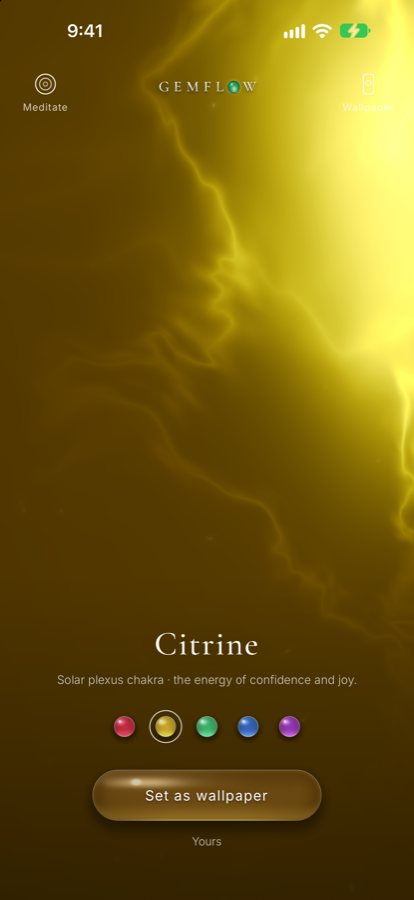
Citrine, the golden stone of the solar plexus chakra, as a living light in the Gemflow app.
When your light feels dim
Have you been living by everyone’s wishes but your own?
Perhaps you are the one who keeps the peace, who notices what everyone else needs before they ask. Somewhere along the way your own voice grew faint. You long to wake up, to feel that your life is moving towards something, but you are not sure what you want, or whether you are allowed to want it. That longing for direction is not a weakness. In the old picture of the body, the sense of direction itself lives here, in the warm center of you.
Manipura · Maṇipūra
A city of jewels inside you
The Sanskrit name of the solar plexus chakra is Manipura (Maṇipūra). It holds the word maṇi, jewel, and is often translated “city of jewels”. An old Tantric commentary gives its own reason for the name: because of the fire that lives in it, the lotus is “lustrous as a gem”. What a beautiful thing to know about yourself: that at your center there is something that shines. In yoga traditions this chakra is linked with will, self-worth, and the power to turn a wish into a step. Many people feel it as a warmth, or a tightness, just below the ribs when they are about to speak up.
Rain clouds and fire
The lotus that hides the rising sun
“Above it, and at the root of the navel, is the shining Lotus of ten petals, of the colour of heavy-laden rain-clouds.”
That is how the Sat-Chakra-Nirupana (Ṣaṭ-Cakra-Nirūpaṇa), written by Pūrṇānanda in Bengal in 1577, pictures the solar plexus lotus: ten petals dark as storm clouds, and at its heart a triangle of fire “shining like the rising sun”. On the petals are letters the color of the blue lotus. The fire’s seed sound is Raṃ, and its god rides a ram. Rain clouds wrapped around a sunrise: it is the most hopeful picture in the whole old map. Your fire was never put out. Sometimes it is simply behind the clouds.
Citrine
A golden light to find your own shine
Today the solar plexus is painted yellow, the color of sunlight and late gold, and citrine is its classic stone. Citrine is traditionally seen as a stone of warmth, optimism and confidence; the pairing follows the shared color, not an old text. Many people keep a piece of citrine close on days that ask for courage: in a pocket before a difficult conversation, on a desk while they start something new. It does not give you a fire you do not have. It reminds you of the one you do.
Your inner sun
From the earth to the fire
In the old picture the chakras rise like lotuses along the spine. Below the solar plexus lies the root chakra, red and steady, the earth that holds you. Above it lies the heart. The fire sits between them: once you feel held, your own warmth can begin to rise. And there is an older thread in the name “solar” plexus. The small sun at your center answers the great sun above you. When you sit with your inner fire, you are not only turning inward; you are remembering that you are made of the same light as the sky.
A ritual
Kindling your inner fire
- Sit with your spine tall and your shoulders soft. Rest one hand, or both, just above your navel.
- Hold a piece of citrine there, or let citrine’s golden light glow in Gemflow in front of you, with 528 Hz playing softly.
- Breathe into your hand. With each in-breath, imagine a small golden flame beneath it growing a little brighter and a little warmer.
- With each out-breath, let the clouds around it thin. Notice anything you have been carrying for others that is not yours to carry.
- If you like, hum a soft ram on the out-breath and feel it warm the space under your ribs.
- Before you open your eyes, say one sentence of your own intention. For example: I trust my own fire.
The rainbow road
How the fire changed its colors
Of all the chakras, the solar plexus has worn the most different colors on its way to us: storm-dark, then red and green, then gold.
- 1577 · In Bengal, Pūrṇānanda writes the Sat-Chakra-Nirupana (Ṣaṭ-Cakra-Nirūpaṇa). The navel lotus has ten petals dark as rain clouds, and a fire inside like the rising sun.
- 1919 · Sir John Woodroffe, writing as Arthur Avalon, carries the text into English as The Serpent Power.
- 1927 · C. W. Leadbeater, in The Chakras, describes the navel center as a wheel of ten spokes: “a curious blending of several shades of red, though there is also a great deal of green in it.”
- Today · Over the 20th century the seven chakras came to be painted as a rainbow, and the solar plexus took the gold between orange and green. Every age has seen the same fire in its own color.
Your daily companion
Citrine and 528 Hz in Gemflow
In Gemflow, the solar plexus is citrine: a golden light that glows from deep inside the stone, warm at the center and amber at the edges, alive on your screen and never the same twice. Touch it and it follows you. Open Meditate and it rises and settles with your breath while a soft 528 Hz tone hums beneath guqin and singing bowls. One minute a day to come back to your own fire. More about its tone: 528 Hz, the love frequency; more about the stone: citrine. Born in November? Citrine is also your birthstone: the November birthstone.
Walk the other chakras
Every chakra has its own color and its own stone: which stone goes with each chakra color. For the frequency of each, see the chakra stones and frequencies chart. Below the fire: the root chakra, the red light that brings you home. Above it: which stone belongs to the heart chakra, and the throat chakra, where your silence becomes a voice.
The solar plexus chakra at a glance
| Sanskrit name | Manipura (Maṇipūra), from maṇi, jewel Avalon 1919, introduction |
|---|---|
| Where | At the root of the navel; today, the solar plexus Verse 19 |
| Petals | Ten, “of the colour of heavy-laden rain-clouds” Verse 19 |
| Letters on the petals | Ḍa to Pha, the color of the blue lotus Verse 19 |
| Element | Fire, a triangle “shining like the rising sun” Verse 19 |
| Seed sound | RAM (Raṃ) Verse 19, commentary |
| Carrier and deities | The fire god on a ram; Rudra, “of a pure vermilion hue”; Lākinī, “clothed in yellow raiment” Verses 20–21 |
| Color in 1927 | Shades of red, with a great deal of green Leadbeater, The Chakras |
| Color today | Yellow Modern rainbow system |
| Stone (modern) | Citrine and other yellow stones Modern crystal practice |
| In Gemflow | Citrine, 528 Hz Gemflow app |
Verse numbers refer to the Sat-Chakra-Nirupana (1577) in Arthur Avalon, The Serpent Power (1919).
Questions
What color is the solar plexus chakra?
The solar plexus chakra is yellow in the modern system. In the 1577 Sat-Chakra-Nirupana its ten petals are dark as rain clouds around a red triangle of fire; Leadbeater (1927) described it as red and green.
What does Manipura mean?
Manipura (Maṇipūra) is the Sanskrit name of the solar plexus chakra, often translated “city of jewels”. Avalon’s Serpent Power (1919) explains it as a lotus “lustrous as a gem” because of its inner fire.
Where do the solar plexus chakra’s colors come from?
The solar plexus chakra’s colors come from three layers: the 1577 Sat-Chakra-Nirupana (rain-cloud petals, fiery triangle), Leadbeater’s The Chakras (1927, red and green), and the 20th-century rainbow system (yellow).
Which stone goes with the solar plexus chakra?
Citrine is the stone most often paired with the solar plexus chakra, following its modern yellow color; tiger’s eye and yellow jasper are also common. The older Sanskrit texts do not name a stone.
Which frequency goes with the solar plexus chakra?
The solar plexus chakra is usually paired with 528 Hz, a Solfeggio frequency, in modern meditation music. The pairing is modern practice, not from the older texts. In Gemflow, citrine carries 528 Hz.
How do I meditate with citrine?
To meditate with citrine, sit tall, hold the stone just above your navel and breathe slowly for a few minutes, imagining a golden flame growing brighter there. End with one sentence of intention.
Can citrine heal me?
Citrine is not a medical treatment. People use it as a companion for meditation and ritual, and as a reminder of their own confidence and warmth.
Notes and sources
- Pūrṇānanda, Ṣaṭ-Cakra-Nirūpaṇa (Sat-Chakra-Nirupana, 1577), in Arthur Avalon (Sir John Woodroffe), The Serpent Power (1919). Verse 19: “the shining Lotus of ten petals, of the colour of heavy-laden rain-clouds”; the letters Ḍa to Pha “of the colour of the blue lotus”; “the region of Fire, triangular in form and shining like the rising sun”; the commentary glosses the rain-cloud color as “of a dark hue”. Verse 20: Fire “seated on a ram… radiant like the rising Sun”, and Rudra “of a pure vermilion hue”. Verse 21: Lākinī, “dark (of complexion), clothed in yellow raiment”. Introduction: the lotus is called Manipura “according to the Gautamiya Tantra, because, owing to the presence of the fiery Tejas, it is lustrous as a gem (Mani)”.
- C. W. Leadbeater, The Chakras (Theosophical Publishing House, 1927): the navel center receives “a primary force with ten radiations”; “Its predominant colour is a curious blending of several shades of red, though there is also a great deal of green in it. The divisions are alternately chiefly red and chiefly green.”
- Kurt Leland, Rainbow Body: A History of the Western Chakra System from Blavatsky to Brennan (Ibis Press, 2016), on how the rainbow sequence took shape in the 20th century.
- Pairing citrine and 528 Hz with the solar plexus chakra is a modern meditation practice. Gemflow is for relaxation, meditation and ritual; it is not a medical product.
© 2026 Gemflow · Home · Chakra colors · Chakra stones chart · Root chakra stone · Heart chakra stone · Throat chakra stone · Crown chakra stone · November birthstone · 528 Hz · Ruby · Citrine · Emerald · Sapphire · Amethyst · YouTube · Privacy